What Retrieval-Augmented Generation is
Retrieval-Augmented Generation (RAG) is a way of making a Large Language Model answer with help from external information instead of relying only on what it learned during training. Put simply, the system retrieves relevant content from a source of truth, then uses that content to generate the response. If you are asking what is rag, that is the core idea: search first, then write.
The purpose of retrieval augmented generation is straightforward. A general-purpose LLM can produce fluent answers, but it does not automatically know your latest product docs, internal policies, support articles, or knowledge base updates. RAG fills that gap by connecting the model to a retrieval layer, often backed by a vector database and embeddings, so the model can ground its output in current material. That makes it useful where freshness, specificity, or internal context matters more than broad language ability.
Flow
RAG Process Flow
Diagram showing the flow from retrieval to generation in RAG
- User asks a question.
- System retrieves relevant passages.
- LLM generates a response using retrieved content.
A simple RAG flow looks like this: a user asks a question, the system retrieves the most relevant passages, and the LLM turns those passages into a response. Retrieval does the heavy lifting on relevance; generation does the heavy lifting on wording and synthesis. If either part is weak, the answer suffers. Poor retrieval gives the model the wrong context. Poor generation can still misread good context or overstate what the source says.
That is why retrieval augmented generation explained properly is not the same as “just add a search box to ChatGPT”. The retrieval layer needs clean content, sensible chunking, and a ranking method that can surface the right passage, not merely the closest keyword match. The generation layer then needs a prompt that tells the model how to use the retrieved text, when to quote it, and when to say it does not have enough evidence.
RAG is most useful when the answer depends on documents you control and update regularly. It is less useful when the task is purely creative, or when the model already has enough general knowledge to answer well without extra context. It also does not remove the need for review, governance, or evaluation. It reduces some failure modes, but it introduces others, especially around retrieval quality and latency.
For teams comparing options, the practical question is not “what is RAG?” in the abstract. It is whether your use case needs grounded answers from a changing corpus, and whether you can support the retrieval pipeline properly. If that is the problem you are trying to solve, RAG is often the right pattern to explore before you move into implementation details.
How RAG works step by step
A useful way to think about the rag architecture is as a controlled handoff between three jobs: finding relevant material, deciding what is worth passing on, and writing the answer from that material. In production, those jobs are usually separated, even if the product surface makes them look like one smooth interaction.
The first stage is retrieval. The system takes the user query, turns it into embeddings, and compares those vectors against a vector database or another indexed corpus. Chunking matters here. If the source material is split too coarsely, the retriever may miss the exact passage that answers the question. Split it too finely, and you end up with fragments that do not carry enough context to be useful. Good chunking is usually a compromise between semantic coherence and search precision.
Once the retriever has a candidate set, a ranker often reorders the results. This step is easy to skip in a toy demo and hard to ignore in a real system. First-pass retrieval may return passages that are broadly related but not the best match. A ranker can use similarity scores, cross-encoders, metadata filters, recency, or access rules to decide what makes it into the final context. In enterprise settings, this is where governance starts to matter: the best semantic match is not always the right answer if the document is stale, restricted, or from the wrong business unit.
The next stage is context assembly. The system builds prompt context from the selected passages, usually with instructions that tell the model how to use them. This is where many llm retrieval augmented generation implementations become brittle. Too little context and the model has to guess. Too much context and you waste tokens, increase latency, and dilute the signal. Teams often do better by being selective: include the passages that directly support the answer, add source metadata where useful, and keep the instruction layer tight. The model should know whether it is expected to quote, summarise, compare, or refuse if the evidence is weak.
diagram
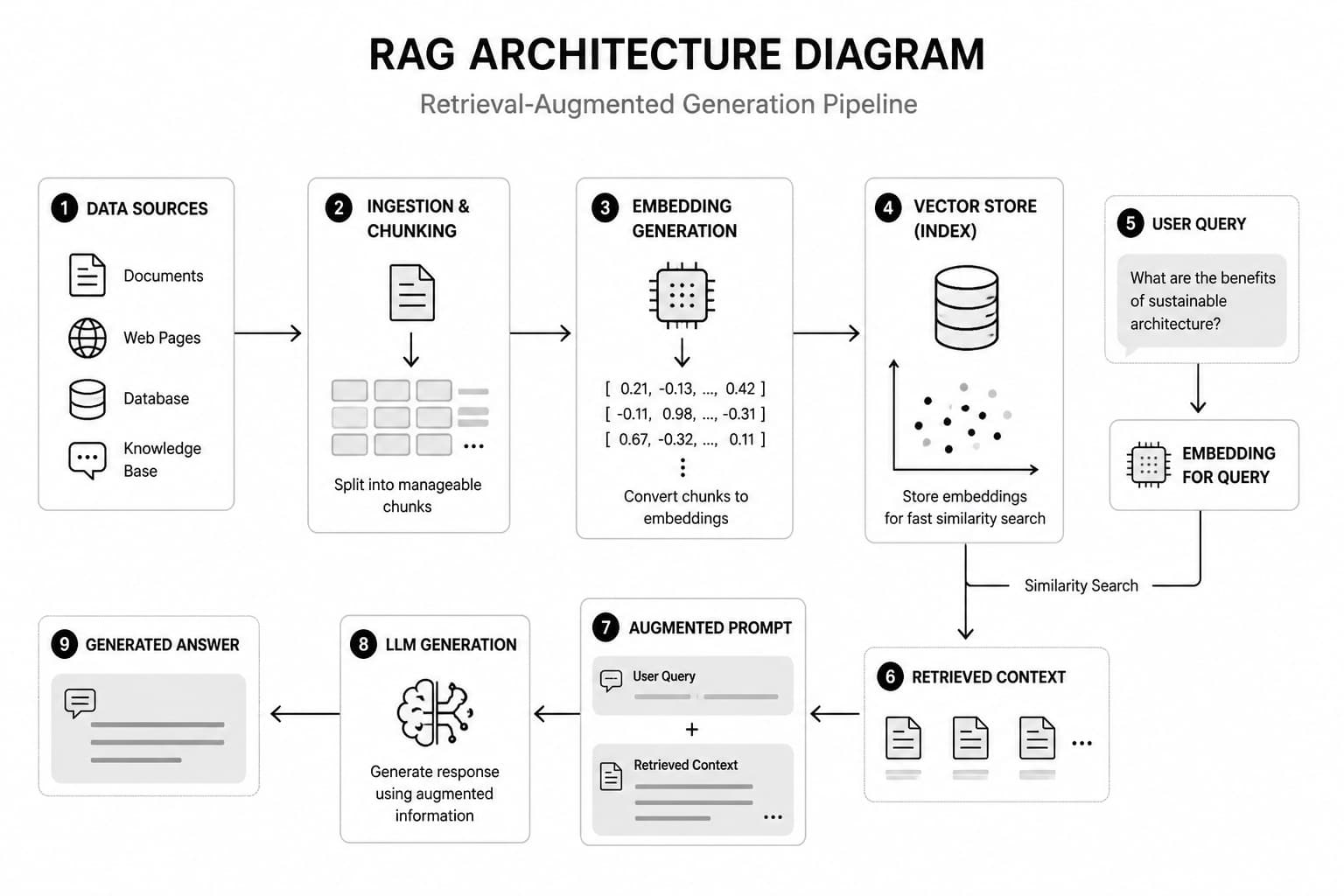
Generation comes last. The large language model reads the prompt context and produces the response. At this point, the model is not “searching” in the usual sense; it is composing an answer from the supplied material and its own language capabilities. The quality of the output depends on the retrieval pipeline, the prompt design, and the model’s ability to stay grounded in the provided evidence. If the retrieved context is thin or contradictory, the model may still produce a fluent answer that sounds confident but is not well supported. RAG reduces that risk, but it does not remove it.
In practice, the rag pipeline is usually wrapped with supporting steps: query rewriting, caching, batching, access control, and logging. Query rewriting can help when users ask vague or underspecified questions. Caching can reduce repeated retrieval work for common queries. Batching matters when you are embedding large document sets or serving many requests at once. Logging is non-negotiable if you want to debug relevance failures, measure latency, or compare retrieval strategies over time.
A simple implementation might look like this:
- Ingest documents and clean the source text.
- Split content into chunks with sensible boundaries.
- Create embeddings for each chunk.
- Store vectors and metadata in a vector database.
- On query, embed the question and retrieve candidate chunks.
- Rank or filter the candidates.
- Assemble prompt context from the best matches.
- Send the prompt context to the model and generate the answer.
- Record the query, retrieved chunks, and response for evaluation.
If you are using LangChain, FAISS, Pinecone, or a similar stack, the shape of the flow stays the same even if the plumbing changes. The main design choice is not the library; it is how much control you need over retrieval quality, freshness, and access rules. For teams working on AI SEO and content systems, the same logic applies to entity coverage and source grounding: the better the retrieval layer understands your corpus, the more reliable the downstream answer tends to be.
RAG vs prompting vs fine-tuning
| Approach | Knowledge Freshness | Control | Implementation Effort | Cost |
|---|---|---|---|---|
| RAG | High | Moderate | Medium | Variable |
| Prompting | Low | Low | Low | Low |
| Fine-tuning | Low | High | High | High |
The choice usually comes down to three things: how often your source material changes, how much control you need over the answer style, and how much engineering effort you can afford.
Plain prompting is the lightest option. You give the model instructions, maybe a few examples, and let prompt engineering do the rest. It works well when the task is stable, the answer space is narrow, and the model already knows enough to respond well. Internal policy drafting, tone control, and short-form classification often sit here.
The limit is straightforward. The model can only use what is already in its weights and whatever fits inside the context window. If the answer depends on current product details, live documentation, or a changing knowledge base, prompting alone becomes brittle.
Fine-tuning sits at the other end. It changes model behaviour through model training, so it suits cases where you want consistent output format, domain-specific language, or a repeatable task that does not depend on fresh facts. It can be the right choice for classification, extraction, or style alignment.
It is less attractive when the underlying knowledge changes often, because updating the model is slower and more expensive than updating a retrieval layer. Fine-tuning also does not solve grounding by itself. A tuned model may sound more confident, but it still needs a reliable source of truth if factual accuracy matters.
That is where rag vs fine tuning becomes a practical decision rather than a theoretical one. Use RAG when the answer should reflect current or proprietary information, and when you want to update knowledge without retraining the model. Use fine-tuning when you need the model to behave differently, not just know different facts.
If you are choosing between them for a support assistant, product documentation, or policy lookup, RAG is usually the first thing to test. In those cases, knowledge freshness matters more than memorising patterns.
RAG vs prompting is often the simpler comparison. Prompting can work well if the answer already fits in the model’s context window and the task does not need external evidence. RAG is better when the model needs to consult a larger or changing corpus before answering.
That does not mean RAG is always the answer. If your corpus is tiny, static, and easy to paste into a prompt, retrieval adds unnecessary complexity. If your corpus is large, messy, or updated weekly, retrieval becomes the cleaner option. For adjacent background on indexing and retrieval, see how AI search works.
A useful rule of thumb is this: choose prompting for behaviour, fine-tuning for repeatable behaviour at scale, and RAG for knowledge access. In many teams, the right system ends up combining all three. Prompt engineering shapes the response, retrieval supplies the facts, and fine-tuning is reserved for cases where the model’s output format or domain language needs to be more consistent than prompting can deliver.
When to use RAG also depends on operational constraints. If you need auditability, source attribution, or a way to swap documents without touching the model, RAG gives you more control. If latency is the main concern and the answer can be generated from a short, fixed prompt, the extra retrieval step may not be worth it.
If your team does not yet have clean content, stable metadata, or a clear evaluation plan, fine-tuning will not rescue that. Start with the problem you actually have: stale knowledge, inconsistent style, or weak task performance. Then choose the smallest approach that addresses it.
Common RAG architecture patterns
Trade-offs in RAG Architecture Patterns
| Pattern | Strengths | Weaknesses |
|---|---|---|
| Dense Retrieval | Simple, cost-effective | Limited control over retrieval quality |
| Hybrid Retrieval | Handles mixed content types | Complex to tune |
| Reranking | Improves precision | Adds latency |
| Metadata Filters | Enhances control | Requires disciplined management |
| Local vs Managed | Customisation vs reduced operational burden | Operational complexity vs dependency on provider |
Teams usually end up with one of a few RAG architecture patterns, and the right one depends on how much control they need over retrieval quality, freshness and operating cost. The simplest setup is dense retrieval against a vector database, where embeddings find semantically similar chunks and the top results go to the model. This is the pattern most people picture first, and it is often enough for small, well-curated corpora where recall matters more than fine-grained control.
A more resilient option is hybrid retrieval, which combines semantic search with keyword matching. In practice, this helps when exact terms matter as much as meaning: product codes, legal phrases, error messages, or names that embeddings may not rank highly on their own. Hybrid search is usually a better fit than pure vector database RAG when the corpus contains mixed content types or when users ask in messy, real-world language. It does add complexity, because you have to tune how the two retrieval signals are merged, but that trade-off is often worth it.
Many production systems also add reranking after the first retrieval pass. The retriever casts a wide net; the reranker then scores the candidates more carefully before the prompt is assembled. This extra stage can improve answer quality, especially when the first-pass retrieval returns plausible but loosely related passages. It also gives teams a clearer place to inspect failures. If the right document is never retrieved, the problem sits upstream. If it is retrieved but ranked too low, the issue is in the reranking layer.
Metadata filters are another common pattern, and they matter more than teams expect. A vector database can retrieve semantically similar content, but without filters it may mix draft and published material, old and current policy, or content from the wrong region. Filtering by source, date, product line or access level keeps retrieval grounded in the right slice of the corpus. In enterprise settings, this is often the difference between a useful system and one that looks good in demos but fails under governance constraints.
There is also a practical distinction between local and managed retrieval stacks. FAISS is often used when teams want a lightweight, self-hosted index and are comfortable owning more of the retrieval layer themselves. Managed vector databases reduce operational burden, but they do not remove the need to design chunking, embeddings, filters and evaluation properly. The database is only one part of the system.
For teams evaluating RAG architecture patterns, the question is rarely “which is best?” It is “which failure mode can we tolerate?” Pure vector retrieval is simpler and cheaper to reason about. Hybrid retrieval handles messy language better. Reranking improves precision but adds latency. Metadata filters improve control but require disciplined content management. Before you commit, map the pattern to the kind of queries you expect, the freshness of the source material and the level of governance your product needs.
What you need to implement RAG in production
Before you put RAG into production, treat it as an operating model, not a model choice. The usual failure point is not the LLM itself. It is weak source data, unclear ownership, and a retrieval layer that looks fine in a demo but falls apart under real traffic.
A useful rag implementation checklist starts with corpus preparation. Decide what content is in scope, what is excluded, and who owns updates. If the corpus includes stale policies, duplicated product notes, or half-finished drafts, the system will surface noise with confidence. Clean source material matters more than many teams expect.
You also need a chunking strategy that fits the content type. Long technical docs, short FAQs, tables, and policy pages should not all be split the same way. Chunk size, overlap, and document boundaries affect retrieval quality directly, so this is not something to leave until the end.
The embedding model is the next decision. Pick one that fits the language, domain, and latency constraints of your use case, then test it against your own content rather than assuming general benchmarks will hold. The same applies to the vector database. The right choice depends on scale, update frequency, filtering needs, and operational overhead. A small internal tool and a customer-facing system with frequent index refreshes do not need the same setup.
The retrieval pipeline should be designed before launch, not improvised after the first poor answer. Define how queries are rewritten, how many candidates are fetched, whether a ranker is used, and what happens when retrieval returns weak evidence. If the system cannot find enough relevant material, it should fail safely rather than force a confident answer. Prompt template design matters here too. The generator needs clear instructions on how to use retrieved context, what to do when evidence conflicts, and when to say it does not know.
Caching and batching are often the difference between a prototype and something that can survive production load. Cache repeated queries, repeated embeddings, and repeated retrieval results where the content changes slowly. Batch embedding jobs and index refreshes where possible, but do not create stale results for fast-moving content. If your corpus changes daily, your refresh cadence should reflect that. If it changes hourly, you need a tighter operational loop and clearer monitoring.
A practical rag production checklist also includes governance. Decide who can add content, who approves updates, how deletions are handled, and how sensitive material is excluded from retrieval. Without that, the system may expose content that was never meant to be answerable. This matters most in regulated environments, or anywhere the source material includes customer data, internal notes, or legal language.
Before launch, check three things: the corpus is clean and owned, the retrieval pipeline is measurable, and the prompt template has been tested against bad retrieval as well as good retrieval. If those pieces are not in place, the model is not the problem.
How to evaluate RAG quality and reliability
Key RAG Evaluation Metrics
| Metric | Purpose | Interpretation |
|---|---|---|
| Precision | Measures relevance of retrieved passages | Higher precision indicates more relevant results |
| Recall | Measures completeness of retrieval | Higher recall indicates more comprehensive evidence gathering |
| Groundedness | Checks if responses are based on retrieved material | Higher groundedness reduces unsupported claims |
| Latency | Measures time taken for retrieval and generation | Lower latency indicates faster response times |
| Cost | Measures resource usage and expense | Lower cost indicates more efficient operations |
The cleanest way to judge a RAG system is to separate retrieval quality from answer quality. Mix them together, and you end up fixing the wrong layer. A model can produce a fluent answer while pulling weak evidence, and a strong retriever can still fail if the prompt, context window or generation settings are off.
For retrieval, the most useful rag evaluation metrics are usually precision and recall at the top of the result set, plus some measure of ranking quality. Precision tells you whether the passages returned are actually relevant. Recall tells you whether the system found the evidence it should have found. In practice, the top few results matter most, because that is what the generator sees. If the right source sits on page two of the retrieval output, answer quality will usually suffer.
Answer quality needs a different lens. Groundedness is the main check: does the response stay close to the retrieved material, or does it add unsupported claims? Hallucination detection should not be treated as a simple pass or fail. It is more useful to score the type of error. Some answers invent facts. Others overstate certainty. Others answer the question but miss a constraint in the source material. Those failures need different fixes.
Latency and cost need the same discipline. RAG latency is not just model time; it includes query rewriting, retrieval, reranking, context assembly and generation. Measure each stage separately so you can see where the delay comes from. A system that feels fast in a notebook can become slow once you add filters, reranking and larger context windows. Cost follows the same pattern. More retrieved chunks, larger prompts and repeated calls to the model all increase spend.
A/B testing is the cleanest way to compare versions once you have a baseline. Test one change at a time: a new embedding model, a different retrieval depth, a tighter prompt, or a new reranker. Use a fixed set of representative queries, then review both automated scores and human judgement. Automated metrics are useful, but they will not catch every case where the answer is technically grounded and still unhelpful.
Monitoring should continue after launch. Track retrieval hit rates, answer rejection rates, latency percentiles and the kinds of questions that trigger weak responses. If the system starts drifting, the cause is often upstream: stale content, changed user intent or a retrieval setting that no longer matches the corpus. That is why AI SEO work around AI Search is not only about content structure and entity optimisation; it also includes measurement and quality control for systems that surface your content in AI Overviews and LLM citations.
Risks, limitations and common failure modes
The biggest mistake is treating retrieval as a substitute for judgement. If the source material is messy, out of date or poorly governed, RAG will surface that mess faster and with more confidence. It does not fix weak content hygiene, and it does not remove the need to review sensitive outputs.
Stale indexes are a common failure mode. Teams update the underlying documents, then forget to refresh embeddings or rebuild the index on a sensible schedule. The system keeps answering from old material, which is especially risky for pricing, product policy, legal copy or anything tied to operational change. Retrieval drift creates a similar problem: the corpus changes shape over time, so the passages that used to rank well no longer reflect the current intent of the question.
Latency is another trade-off that gets ignored early on. Every retrieval step adds time, and the cost rises when you add reranking, larger context windows or repeated queries. That may be acceptable for an internal assistant, but it becomes a problem if users expect near-instant responses. If the system feels slow, people stop trusting it even when the answer is technically sound.
Security, privacy and governance are where many RAG risks become business risks. A retrieval layer can expose content that should not be visible to every user, or it can pull in documents that were never meant to inform customer-facing answers. Access control, document classification and audit trails need to be designed into the system, not bolted on later. This matters just as much as model choice.
There is also a subtle failure mode in how teams judge success. A response can sound polished while still being weakly grounded, and a retrieval pipeline can look healthy while missing the documents that matter. If you only review the final answer, you miss the real issue. If you only inspect retrieval, you miss generation errors and prompt problems.
Treat RAG as a controlled system, not a shortcut. Before you ship, check whether your index refresh process, access rules and review workflow are strong enough for the data you plan to expose. If they are not, fix those first; otherwise the model will just make your existing weaknesses more visible.
Next steps for engineering and product teams
For teams deciding whether to build a RAG system, the useful question is not “can we do this?” but “what do we need to prove first?” Start with a narrow pilot scope that reflects a real business task, not a generic demo. Pick one content domain, one user group, and one answer type. If the system is meant to support customer-facing knowledge, define which questions it must answer, which sources it may use, and where it should refuse to answer. That gives engineering, product, and compliance teams something concrete to test against.
From there, set the roadmap around evidence rather than enthusiasm. The first milestone should confirm that the corpus is usable: content is current, ownership is clear, and data governance rules are understood. The second should test retrieval quality on a small but representative set of queries. The third should check whether the generated answers stay grounded when the retrieved context is imperfect, incomplete, or noisy. That sequence matters because a polished demo can hide weak retrieval, and weak retrieval will surface later as support burden or user mistrust.
A good evaluation plan needs more than a pass/fail judgement. Define what success looks like for relevance, answer quality, latency, and cost, then decide who signs off on each. Product teams usually care about usefulness and coverage. Engineering teams care about system behaviour under load. Legal, security, or operations may care about what content can be exposed and how updates are controlled. If those stakeholders are not involved early, the rollout tends to stall when the first governance question appears.
For implementation, keep the first version small enough to inspect manually. Use a limited corpus, a clear retrieval policy, and a simple prompt structure. Add caching and batching only after you understand the baseline behaviour, because premature optimisation can hide the real bottleneck. If you are comparing options, do not choose tools on brand recognition alone; choose them on how well they fit your data shape, update frequency, and team skills. That is usually where a build rag system decision becomes practical rather than theoretical.
The same applies to the rollout itself. Treat it as a staged release, not a one-off launch. Build a roadmap that includes index refresh ownership, review cadence, failure handling, and a plan for expanding scope once the pilot proves stable. If the team cannot explain who maintains the sources, who reviews bad answers, and how changes reach production, the system is not ready for wider use.
For organisations also thinking about AI search visibility, this is where the work connects to broader AI SEO. The same discipline that improves retrieval quality - clean entities, structured content, clear source ownership, and consistent terminology - also helps content perform better in AI Search and AI Overviews. If you need help shaping that strategy, the next step is usually to align the technical pilot with the content and governance work that supports it. If you need help shaping that strategy, the next step is usually to align the technical pilot with our AI SEO services.