What a SaaS SEO strategy needs to do
A SaaS SEO strategy has to do more than lift organic traffic. It should build an Organic Pipeline that brings the right people into the Buyer Journey, then moves them towards a Free Trial, Demo Requests, or another meaningful conversion tied to Recurring Revenue. If a page attracts visits but never reaches Commercial Intent, it is not pulling its weight.
That changes how you plan an SEO strategy for SaaS. You are not just chasing broad keywords or publishing content for the sake of volume. You need a mix of acquisition pages, product-led content, and support content that answers real buying questions at the right moment. Feature Pages, Integration Pages, Comparison Pages and Alternative Pages often do more commercial work than generic blog posts because they match how buyers actually search when they are close to a decision.
A strong b2b saas seo strategy also has to respect the product. If the site architecture is messy, Technical SEO problems will block growth long before content becomes the issue. If the messaging is vague, organic traffic will not convert. Weak Internal Linking makes it harder to build Topical Authority around the terms that matter.
The goal is straightforward: make search a repeatable demand channel, not a one-off traffic spike. That means aligning Content Strategy, Conversion Rate Optimisation and measurement around pipeline quality, not vanity metrics. For most SaaS teams, that is the difference between SEO that looks busy and SaaS SEO that actually supports revenue.
How SaaS SEO differs from standard SEO
SaaS SEO is not just a smaller version of standard SEO. Search demand is usually more specific, the buying cycle is longer, and the pages that matter most are tied to product evaluation rather than broad awareness. In practice, keyword selection has to reflect commercial intent much more carefully. A generic SEO plan might chase volume first; an SEO strategy for SaaS should start by separating acquisition terms from expansion and support terms, then deciding which ones can actually move free trials, demo requests, or assisted conversions.
| Aspect | SaaS SEO | Standard SEO |
|---|---|---|
| Keyword Selection | Focus on commercial intent | Focus on search volume |
| Page Types | Product-led and comparison pages | Blog and informational pages |
| Measurement | Quality of visits and conversions | Organic traffic and rankings |
Page types also behave differently. SaaS teams rarely win by publishing only blog content and hoping it converts later. Searchers want proof that the product fits their workflow, integrates with their stack, or compares well against alternatives. That is why SaaS SEO strategies usually need a stronger balance between product-led pages, comparison content, documentation, and supporting editorial. The content mix should mirror the buyer journey, but it also needs to reflect how people really evaluate software: they scan pricing, check integrations, look for implementation detail, and then decide whether to start a free trial or book a demo.
Measurement is another point where SaaS SEO diverges from standard SEO. Organic traffic matters, but it is not the main event. A useful saas seo roadmap tracks the quality of visits, not just the quantity: demo requests, free trial starts, assisted conversions, branded search growth, and the share of organic sessions landing on pages with commercial intent. If those signals are improving, the channel is doing its job even when rankings move slowly. That is the difference between chasing visibility and building a pipeline.
This is also why SaaS SEO needs tighter prioritisation. Not every keyword deserves a page, and not every page deserves the same level of effort. The strongest programmes focus on the pages most likely to influence revenue, then support them with technical SEO, internal linking, and content that answers objections before a prospect speaks to sales. Done well, SaaS SEO becomes a specialist growth system rather than a generic content exercise, which is why many teams eventually need expert support to plan and execute it properly.
A 90/180/365-day SaaS SEO roadmap
A sensible SaaS SEO roadmap needs sequencing, not enthusiasm. The first 90 days should be about removing friction and making sure the site can actually earn and keep organic visibility. Fix crawl and indexation issues. Tighten canonicals. Clear out thin or duplicated pages. Check internal linking. Make sure key product and commercial pages are easy to find.
If the site is slow, messy, or hard to crawl, content work will underperform, no matter how strong the briefs are. This is also the point to define the keyword set by business priority, so the team knows which pages support acquisition, which support demand generation, and which are there to improve conversion rate optimisation later in the funnel.
By day 180, the focus should shift to building topical authority around the highest-value problems your product solves. For most B2B SaaS teams, that means a disciplined content strategy rather than a scattergun publishing plan. Create clusters that map to real search intent, then connect them with internal linking so authority flows towards the pages that matter commercially.
This is where a b2b saas seo strategy starts to compound: one strong guide can support several supporting articles, a product page, and a demo request path if the structure is deliberate. At this stage, you should also start earning backlinks through genuinely useful assets, data-led commentary, and partnerships that make sense for the category.
By day 365, the work should look less like “doing SEO” and more like operating an organic growth channel. The site should have a clearer information architecture, stronger topical authority, and a repeatable publishing and optimisation cadence. You should be reviewing which pages drive free trial starts, demo requests, assisted conversions, and downstream revenue signals, then reallocating effort accordingly.
timeline
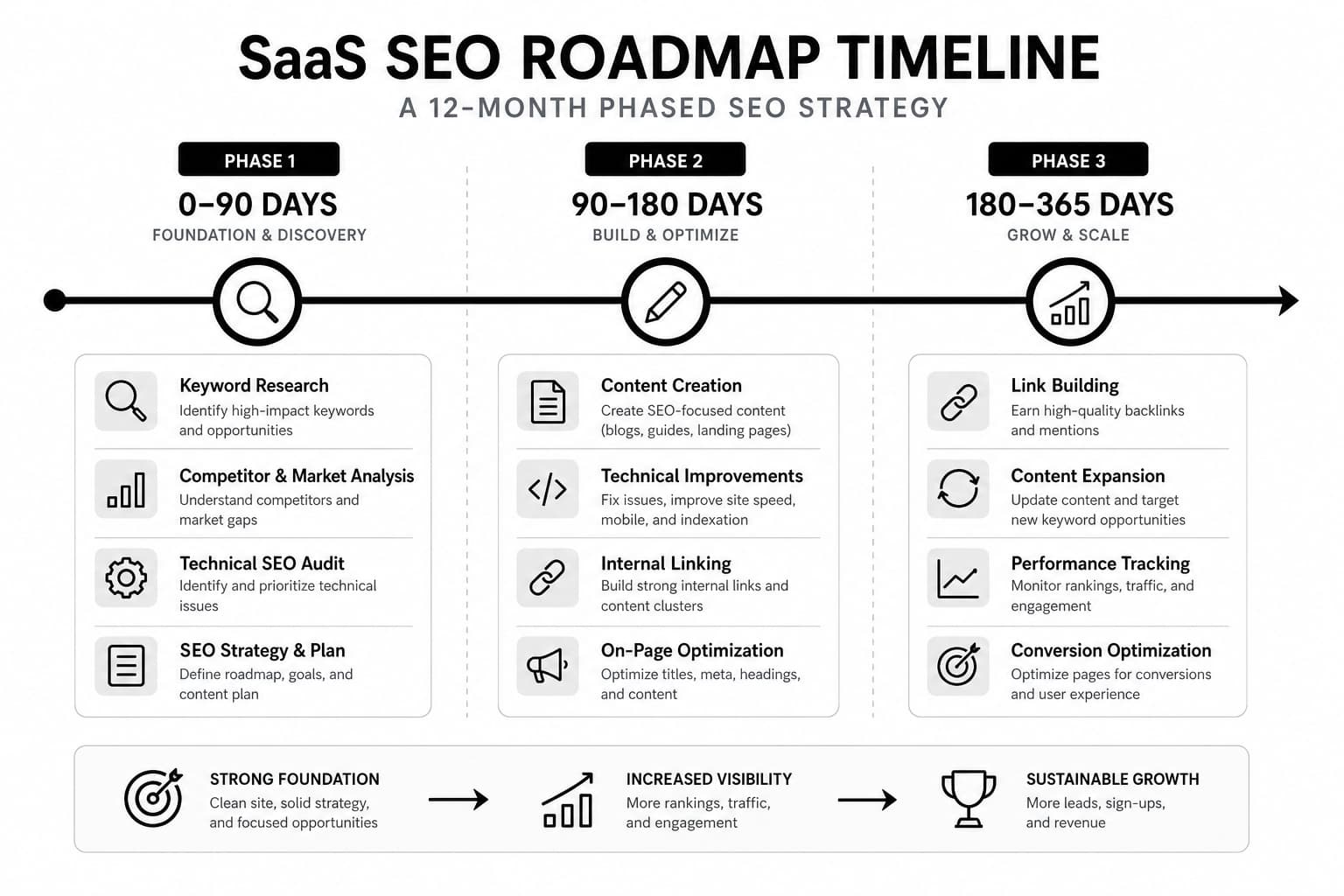
Some pages will deserve refreshes, some will need stronger internal linking, and some will need to be retired or merged. That judgement matters. A mature saas seo roadmap is not about publishing more; it is about improving the pages and pathways that already have commercial value.
If you want the simplest version of the plan, think in three moves: stabilise the technical base, build authority around priority topics, then optimise for conversion and scale. That sequence keeps the saas seo strategy grounded in business outcomes rather than vanity metrics, and it gives SaaS teams a realistic way to grow organic demand without treating every quarter like a reset.
Technical foundations that unlock growth
Before you scale content, the technical base needs to be dull in the best possible way: stable, predictable and easy for search engines to read. In SaaS SEO, that means the right pages can be discovered, the right URL version can rank, and the site renders without getting in the way. If those basics are shaky, strong content still underperforms because authority gets leaked, crawl budget gets wasted, or search engines receive mixed signals about what matters.
Start with crawlability and indexation. Product pages, docs, pricing, comparison content and support articles should be easy to reach through the main navigation or a sensible internal structure, not hidden behind filters or JavaScript-only paths. Then check the index itself. Pages that should rank need to be indexable; thin, duplicate or utility pages should be kept out on purpose. In a SaaS SEO strategy, this is not tidy-up work. It decides whether search engines spend time on pages that can drive demo requests or free trial sign-ups.
Canonicalisation needs the same level of care. SaaS sites often create near-duplicate URLs through parameters, sorting, localisation, or app and marketing subdomains. Left unchecked, that muddies the picture and dilutes signals. Canonical tags, redirects and consistent URL rules should point search engines to one preferred version of each page. One page. One intent. One ranking signal.
Site speed matters too, but not as a vanity metric. Slow templates usually hit the pages that matter most: feature pages, pricing, and high-intent content close to conversion. The usual culprits are easy to spot — oversized scripts, bloated third-party tags, uncompressed media, and poor Core Web Vitals on mobile. Technical SEO for SaaS should make the site feel quick enough that users can move from search result to product evaluation without friction.
Treat technical SEO as a release gate for content scaling. If the site cannot be crawled cleanly, indexed correctly, and served quickly, publishing more pages only adds noise. Once the foundation is stable, content has room to compound instead of fighting avoidable technical issues. That is when a SaaS SEO strategy starts to behave like a growth system, not a pile of disconnected pages.
How to prioritise keywords for SaaS
The quickest way to waste SaaS SEO effort is to treat every keyword as equal. A better approach is to sort opportunities by the job they do in the business. Most teams need three buckets: acquisition, expansion and support. That simple split keeps keyword research tied to commercial intent, not vanity volume.
Acquisition keywords bring new buyers into the market. They usually sit around problems, categories and alternatives, and they belong on pages that can win attention from people still comparing options.
Expansion keywords are different. They support existing demand around features, use cases, integrations and workflows, and they often work best when the page can move a visitor from curiosity to trial or demo request.
Support keywords are the lowest-friction group, but they still matter because they reduce churn, answer product questions and keep the brand visible after signup. Ignoring them is a mistake; they may not drive the first click, but they can protect recurring revenue.
A useful SaaS SEO strategy is to score each keyword against four questions: how close it is to revenue, how well it matches search intent, how much authority the site already has for the topic, and how clearly the page can convert. A keyword with modest volume can outrank a bigger term in priority if it sits closer to commercial intent and can be served by a page that already has a strong role in the buyer journey. That is the kind of judgement good keyword research should produce.
Page type matters too. Not every term deserves a blog post. Some belong on feature pages because the searcher wants to understand capability. Others are better suited to comparison pages because the user is narrowing options and needs a direct answer. Support terms may sit in help content, but they still need to be planned as part of the wider saas seo roadmap rather than left to product teams by accident.
A practical rule: if a keyword can influence trial starts, demo requests or qualified sign-ups, it deserves a higher place in the queue than a term that only attracts broad curiosity. That does not mean you ignore top-of-funnel demand. It means you sequence work so the pages with the clearest commercial value get attention first. That is how saas seo strategies stay focused on pipeline, not just traffic.
Build a content system that compounds topical authority
A content system only earns the label “topical authority” when it does more than publish isolated articles. In SaaS SEO, the aim is to build a structure where each page has a clear job, each cluster strengthens the next, and Internal Linking helps search engines and buyers move through the Buyer Journey without friction. That is where a disciplined content strategy starts to compound.
Think in Hub and Spoke terms. The hub should cover the core problem, category or use case at a level broad enough to attract demand, but specific enough to be commercially useful. The spokes then handle the questions that sit around it: implementation details, feature comparisons, integration considerations, objections, onboarding, and post-sale education. When the hub is written well, it becomes the page that earns relevance for the topic. When the spokes are written well, they deepen Topical Authority and create more entry points for organic traffic.
The mistake many SaaS teams make is treating every article as if it should do the same job. It should not.
Page roles need to be assigned deliberately. Some pages are there to win discovery. Others exist to support evaluation. A third group should help users succeed after signup, which matters more than many marketers admit because retention content can reduce churn and strengthen the wider content strategy. Once those roles are clear, you can map topics to intent without forcing every page to chase the same keyword. Editorial planning becomes cleaner too: writers know whether they are building a pillar, a supporting article, or a conversion-focused asset.
Internal Linking is what turns that structure into a system. Links should not be added as an afterthought or used only to push authority around the site. They should guide readers from broad educational content into more specific pages, then towards the pages that support trial, demo or product evaluation. Done properly, linking also signals which pages matter most. Done badly, it creates a messy archive that looks busy but does little for rankings or pipeline.
For a SaaS content marketing strategy, the real test is whether new content strengthens the existing cluster. If a new article does not support a hub, answer a buyer question, or connect to a commercial page, it probably belongs lower on the priority list. That discipline keeps the site focused, improves crawl efficiency, and makes future content easier to plan. It also gives marketing leaders a cleaner way to explain why content is being created: not for volume, but to build authority in the areas that drive revenue.
This is where a SaaS SEO partner adds value beyond writing. The work is not just producing pages; it is designing the architecture, linking logic and page roles so the site can keep compounding over time.
Link building and authority signals
Backlinks still matter, but SaaS teams often overrate volume and underrate fit. A handful of relevant links from credible industry sites, partner ecosystems, review platforms and specialist publications will usually do more for a saas seo strategy than a pile of weak directory placements. The aim is not to “build links” in the abstract. It is to build authority signals that make sense for a subscription business with a real product, a real category and a real buyer journey — the same commercial logic behind SaaS SEO as an operating programme.
Earning mentions where your audience already pays attention is a better starting point. A useful backlink profile for SaaS usually includes product-led commentary, original data, expert quotes, partner references and references from integration or ecosystem pages. Brand mentions matter too, even when they are unlinked. Search engines are better at understanding entities than they used to be, and repeated mentions across trusted sources can reinforce topical relevance and brand recognition. For founders and marketing leaders, that is the practical takeaway: authority is not just a link metric, it is a visibility pattern.
Internal Linking deserves the same discipline. It is one of the few authority-building levers you fully control, and it should be used to move readers towards the pages that matter commercially. A strong internal structure helps search engines understand which pages deserve prominence, but it also helps users find the next sensible step without friction. In SaaS, that often means a blog post supporting a demo request, a free trial or a deeper product page rather than sitting there as a traffic asset on its own.
A sensible saas link building strategy usually blends three approaches. First, digital PR for genuinely newsworthy angles, such as product research, market observations or data-led commentary. Second, partner-led authority, where integrations, agencies, resellers and platform partners can reference your content naturally. Third, selective outreach to publications that already cover your category and will only link when the material earns it. Push harder than that and you usually create noise, not durable authority.
The best test is simple: would this mention still make sense if search engines did not exist? If the answer is no, it is probably a weak bet. SaaS SEO works best when backlinks, brand mentions and internal linking all point in the same direction — towards clearer topical authority, stronger demand generation and a site that looks like a credible market participant rather than a link-chasing publisher.
Measure results and adjust the plan
The reporting should answer one question: is SEO producing qualified demand, not just more visits? That means tracking saas seo kpis that sit closer to revenue than pageviews. Organic traffic still matters, but only as a starting signal. A rise in visits is useful if it comes with more Free Trial starts, more Demo Requests, and a healthier share of visitors moving into the product. If traffic grows while those actions stay flat, the strategy is probably attracting the wrong intent or sending people to the wrong pages.
I’d keep the core dashboard tight. At minimum, show organic traffic by landing page type, trial and demo conversion rates, assisted conversions, and the cost trend versus paid acquisition. Customer Acquisition Cost is especially useful when leadership wants to know whether SEO is actually changing the economics of growth. It is also worth separating branded and non-branded demand, because a lot of “SEO growth” in SaaS is really just better brand capture. That is not a problem, but it is a different result.
The reporting cadence should be monthly for the team and quarterly for leadership. Monthly reviews are where you spot page-level issues: a comparison page that attracts clicks but no conversions, a support article that pulls in the wrong audience, or a feature page that ranks but fails to move people into the product. Quarterly reviews are where you decide whether to double down, rewrite, or retire content. This is where conversion rate optimisation becomes part of the SEO conversation rather than a separate discipline. If a page earns traffic but underperforms on sign-ups, the fix is often clearer messaging, stronger proof, or a better next step rather than more keywords.
A practical rule: keep the pages that generate qualified organic traffic and improve the ones that do not. It sounds obvious, but many SaaS teams keep publishing around weak themes because the reporting is too shallow to challenge assumptions. Good measurement should make it easy to see which topics support pipeline, which ones support product adoption, and which ones are just noise — the same hierarchy covered in SaaS SEO KPIs. When the data is set up properly, the SaaS SEO strategy becomes easier to defend, easier to prioritise, and much easier to connect back to commercial outcomes.
When to get help with SaaS SEO
In-house teams can handle a lot of SaaS SEO strategy work when the site is already in decent shape, the product is easy to explain, and someone owns execution end to end. If you have a marketer who can brief content properly, a developer who will actually ship fixes, and a founder or head of growth who can make trade-offs, you do not need to outsource everything.
The real test is whether the team has the time and judgement to prioritise the right work, not whether it can produce more pages.
Specialist support tends to pay off when the work becomes cross-functional and the commercial stakes rise. That usually shows up in one of three ways: technical issues are slowing indexation or performance, the content plan is broad but unfocused, or the site needs a stronger bridge between search demand and conversion. A b2b saas seo strategy is rarely held back by one missing blog post; more often, the problem is weak prioritisation, slow implementation, or pages that attract the wrong kind of traffic.
This is where SaaS SEO can be useful. A specialist team should help you decide what to fix first, what to leave alone, and how to connect SEO activity to the organic pipeline rather than vanity metrics. If your internal team is already publishing, but the work is not moving free trial sign-ups, demo requests, or qualified enquiries, outside support can sharpen the plan quickly.
The same applies when you have product complexity, multiple audiences, or a site that has grown messy over time. The best time to bring in help is before the team starts guessing. If you are still debating whether the issue is technical SEO, content strategy, or conversion rate optimisation, that is usually a sign that an experienced pair of eyes will save time.
Good support should not replace your team; it should give them a clearer saas seo strategy and a more realistic path to revenue.