What SaaS SEO means in practice
SaaS SEO is the practice of using search to grow a software business in a way that supports recurring revenue, not just traffic. In plain English, it means creating and optimising the pages, content and site structure that help the right people find your product when they are actively looking for a solution, comparing tools or trying to understand a problem. That usually includes feature pages, comparison pages, integration pages, documentation and commercial content built around clear Search Intent.
The saas seo meaning is easier to grasp if you think about the buyer journey. A visitor might start with a broad problem query, then move to a category search, then compare vendors, then look for proof that your product fits their stack. SaaS SEO is built to meet those stages with useful pages that can earn visibility and move people towards a free trial, demo request or sign-up. It is not about chasing every possible keyword. It is about building an Organic Pipeline that attracts qualified prospects and supports Customer Acquisition Cost efficiency over time.
That is where SaaS SEO differs in practice from generic SEO campaigns. A software company does not usually win by publishing lots of loose informational articles and hoping some traffic converts. It wins by aligning content strategy with product-led growth, commercial intent and the pages that influence buying decisions. If a prospect searches for a comparison, an alternative or an integration, that search has obvious business value. If your site answers it well, you are not just earning clicks; you are shaping consideration.
Good SaaS SEO also has to respect the economics of the business. Recurring Revenue changes the way success should be measured. A single organic visit is not the goal. The goal is to create a search presence that keeps feeding the pipeline with the right mix of awareness, evaluation and conversion opportunities. That means thinking beyond rankings and looking at how search supports demo requests, trial starts and downstream retention.
In that sense, SaaS SEO is a commercial growth channel as much as a marketing discipline. It combines Technical SEO, content planning, Internal Linking and topical authority so search engines can understand the site and users can find the most relevant page quickly. Done well, it gives SaaS teams a durable way to reduce reliance on paid acquisition and build a more predictable Organic Pipeline. Turning that into an executable SaaS SEO strategy is usually the next step after the definition is clear.
How SaaS SEO differs from SEO for other business models
SaaS SEO has a different job from SEO for an ecommerce store, a local business or a generic lead generation site. The aim is not just to pull in more visits. It is to bring the right people in at the right point in the Buyer Journey and move them towards a trial, demo request or sign-up. That changes how you plan pages, choose topics and judge success.
| Aspect | SaaS SEO | Ecommerce SEO | Local SEO | Lead Generation SEO | ||
|---|---|---|---|---|---|---|
| Primary Goal | Drive trial sign-ups and demos | Increase product sales | Attract local customers | Capture leads | ||
| Key Metrics | Demo requests | trial starts | Transaction volume | Local visibility | lead capture | Lead quality |
| Content Focus | Use-case and integration content | Product and category pages | Local listings and reviews | Service and landing pages |
Ecommerce SEO is usually built around product discovery and transaction volume. A retailer wants category pages, product pages and filters to rank, then convert quickly. Local SEO is more immediate: the searcher wants a nearby provider, opening hours, reviews and a phone number. Lead generation SEO often sits somewhere in the middle, with service pages and landing pages designed to capture enquiries.
SEO for SaaS has a longer decision cycle. Buyers compare tools, check integrations, read documentation and look for proof that the product fits their workflow. Commercial Intent matters, but it rarely shows up as one neat high-intent search followed by a fast conversion.
That is why SaaS sites need a broader mix of page types and a more deliberate Content Strategy. A strong SaaS SEO programme usually supports product pages, use-case pages, integration content, comparison content and educational assets that answer specific questions before a prospect is ready to speak to sales. The point is not to publish more content for its own sake. It is to build a structure that matches how software is actually evaluated.
If a prospect is comparing two platforms, a generic blog post will not do much. If they are checking whether your product connects to the tools they already use, the right page can remove friction and shorten the path to action.
The metrics are different too. Rankings still matter, but they are not the main event. SaaS teams need to look at demo requests, free trial starts, activation, pipeline contribution and, where possible, the quality of the leads that organic search brings in. A page that ranks well but attracts the wrong audience can look successful in Search Console and still be poor for the business.
This is where SaaS SEO vs traditional SEO becomes a useful distinction: the work is judged less by traffic alone and more by whether it supports recurring revenue and lowers Customer Acquisition Cost over time.
Technical SEO also carries more weight in SaaS than many teams expect. Product-led sites often grow quickly, which means messy information architecture, duplicate URLs, thin pages and weak Internal Linking can creep in fast. Search engines need to understand the site clearly, but so do users who are moving between product, pricing, help and comparison content. Topical Authority is harder to build when the site is fragmented, so the technical foundation and the content plan have to work together.
The practical takeaway is simple. SEO SaaS work should be designed around how software is bought, not just how keywords are searched. Generic SEO tactics can still help, but they rarely produce the right mix of visibility, trust and commercial outcomes on their own.
Why SaaS SEO matters for growth, not just traffic
SaaS SEO matters because it is one of the few channels that can keep working after the campaign budget stops. Paid media can create demand quickly, but it also stops the moment spend is paused. Organic search takes longer to build, yet it can keep feeding the funnel with qualified visits, demo requests and free trial sign-ups long after the initial work is done. For a SaaS business, that makes SEO less of a traffic play and more of a pipeline asset.
The commercial value comes from fit, not volume. A thousand visits from people who will never buy software is just noise. A smaller stream of searchers actively comparing tools, weighing up solutions or looking for a better way to solve a problem is far more useful. Good SaaS SEO is built around those moments of intent and the pages that can turn them into action. When the content, technical setup and internal linking are aligned, organic search becomes a dependable source of demand generation rather than a vanity metric on a dashboard.
It also changes how leaders should think about acquisition efficiency. If SEO reduces reliance on paid channels, it can improve customer acquisition cost over time. That does not mean SEO is free or easy; it means the economics can become more attractive as pages mature and rankings settle. In a business model built on recurring revenue, that matters. A channel that brings in customers with strong lifetime value can justify more investment than one that only produces short-term clicks.
There is a strategic reason SaaS teams should care as well. Search visibility often shapes how a category is perceived. If your product appears when buyers are researching problems, evaluating approaches or shortlisting vendors, you are influencing the buyer journey before a sales conversation starts. That is valuable even when the final conversion happens later through a demo request or free trial.
In practice, SaaS SEO works best when it is treated as part of the wider growth system. Content strategy, technical SEO, conversion rate optimisation and commercial positioning all need to pull in the same direction. That is the kind of work ChillyLizard focuses on in SaaS SEO, because the goal is not simply more traffic. It is a healthier organic pipeline that supports recurring revenue.
The core page types SaaS SEO relies on
SaaS SEO usually works best when the site is built around the pages buyers actually use while they are evaluating software. The job is not just to publish articles and hope for traffic. It is to create a structure that captures demand at different points in the Buyer Journey, from early problem awareness through to shortlist, trial and purchase.
The most important page types are the ones that answer commercial search intent without forcing the reader through a generic blog post. Feature pages do that by showing how a product solves a specific job, such as reporting, automation or permissions. They are often the first place a prospect looks when they already know the category and want to see whether the product fits their workflow. A strong feature page is not a thin product blurb. It should explain the use case, the outcome, the workflow and the proof points that matter to a buyer comparing options.
Comparison pages are just as valuable because software buyers rarely look at one tool in isolation. They search for direct comparisons when they are narrowing choices, and those pages can capture high-intent traffic that is close to conversion. The best comparison pages are honest. They do not pretend every product is the same, and they do not hide trade-offs. They help the reader understand where your product is stronger, where it is a better fit, and where it may not be the right choice. That kind of clarity tends to build trust faster than a polished sales pitch.
Alternative pages play a similar role, but they usually catch people who are already dissatisfied with a known product or looking for a different route. These pages can be commercially powerful because the searcher has moved beyond broad research. They want a replacement, a cheaper option, a simpler interface or a product with a different feature set. If the page is written well, it can turn a competitor’s weakness into your opportunity without sounding opportunistic.
Integration pages are often overlooked, which is a mistake. In SaaS, integrations are not a side note; they are part of the buying decision. A prospect may be perfectly happy with your core product but still need to know whether it connects to their CRM, analytics stack, billing system or support tools. Integration pages can rank for specific software combinations and also reassure visitors that implementation will not be painful. They work especially well when they explain the practical value of the connection, not just the technical compatibility.
Documentation SEO is another asset that deserves more attention than it usually gets. Good documentation can attract developers, admins and implementation teams who are searching for setup instructions, error fixes or API guidance. That traffic is not always glamorous, but it is highly relevant. It also supports adoption after sign-up, which matters because retention is part of the commercial picture in SaaS. If documentation is structured clearly, searchable and internally linked, it can become a real source of qualified visits rather than a hidden support library.
diagram
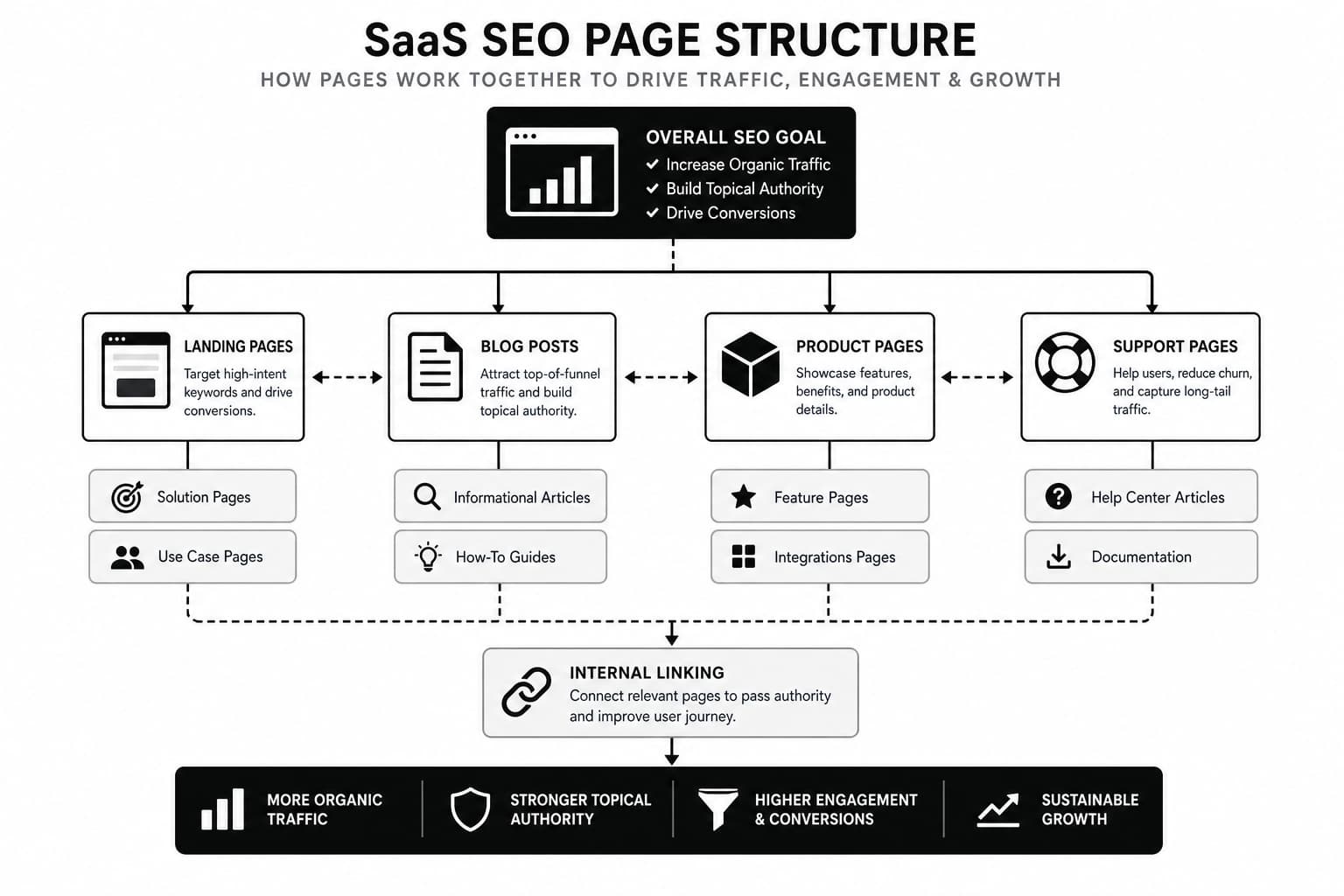
These page types work because they map to different stages of intent. Someone reading documentation may already be using the product. Someone on a comparison page is probably evaluating alternatives. Someone on a feature page may be trying to understand whether the product solves a specific problem. SaaS SEO works when those pages are planned as a system, not as isolated assets.
That is where site architecture and technical SEO for SaaS become important. If search engines cannot crawl, understand and prioritise these pages properly, the whole structure underperforms. The same applies if the pages are buried too deep, duplicated across variants or written in a way that makes them hard to distinguish. A SaaS site needs a clear hierarchy, sensible internal linking and enough topical depth for each page type to earn visibility on its own terms.
The practical takeaway is simple: SaaS SEO should not be treated as a blog-only exercise. The strongest programmes usually combine commercial pages, product-led pages and supporting content so the site can meet buyers where they are. That is the kind of work a serious SaaS SEO programme should be able to plan and execute, because it affects not just traffic, but the quality of the pipeline that traffic creates.
The three pillars of SaaS SEO: technical, content and authority
SaaS SEO works best when three disciplines are pulling in the same direction: technical SEO for SaaS, content strategy and topical authority. Leave any one of them out and the whole thing gets shaky. A site can have strong ideas and still underperform if crawl paths are messy, templates are bloated or important pages are buried too deep. It can be technically sound and still fail to generate demand if the content does not match what buyers are actually searching for. It can also publish plenty of articles without building authority if those pages never connect into a coherent subject area.
Technical SEO is the foundation. In SaaS, that usually means making sure search engines can find, render and understand the pages that matter most to revenue. Fast, clean templates matter because software sites often carry heavy scripts, gated assets and dynamic elements that get in the way. Sensible site architecture matters too. If your feature pages, pricing pages, comparison pages and supporting content sit in a flat, logical structure, you make it easier for both users and crawlers to move through the site. Internal linking is part of that job, not a separate nice-to-have. It tells search engines which pages deserve attention and helps visitors move from broad research into product evaluation without friction.
Content strategy is the layer that turns search demand into commercial opportunity. In SaaS, that means planning content around the buyer journey rather than publishing whatever feels topical that week. A good content strategy identifies the questions prospects ask before they book a demo, the objections they raise during evaluation and the terms they use when comparing options. It also recognises that not every page has the same job. Some pages exist to educate, some to convert, and some to support product-led growth by helping users understand value quickly enough to sign up or request access. Built properly, the content map supports demand generation instead of just filling a blog archive.
Topical authority is what happens when those pages reinforce each other over time. Search engines do not just reward isolated articles; they respond to depth, consistency and clear subject ownership. A SaaS company that publishes one decent guide on a topic is not building authority. A company that covers the topic from multiple angles, links related pages together and keeps the messaging aligned is far more likely to earn trust. That matters in competitive categories where buyers are comparing vendors, not just learning definitions. It also matters for commercial intent queries, where the search results tend to favour sites that look genuinely useful rather than opportunistic.
The three pillars are interdependent. Technical SEO makes the content discoverable. Content strategy gives the site something worth ranking. Topical authority helps the whole system compound. When they work together, SaaS SEO becomes more than traffic acquisition; it becomes a structured way to support recurring revenue, demo requests, free trial sign-ups and better conversion rates across the funnel. That is the standard a serious SaaS SEO programme should be judged against.
How SaaS SEO supports the buyer journey
The buyer journey in SaaS rarely moves in a straight line, so SEO has to meet people where they are rather than trying to push everyone down one path. Someone searching a broad problem term is usually not ready for a sales conversation. They want to understand the category, the pain point, or the options on the table. At that stage, the best SaaS SEO content answers the question plainly and earns trust without overreaching.
As interest sharpens, search behaviour changes. Prospects start looking for commercial intent signals: how one product compares with another, whether there is a better alternative, or whether a specific use case is supported. This is where comparison pages and alternative pages do real work. They help buyers narrow the field, and they do it in a way that reflects how software is actually evaluated. If the page is honest about trade-offs, it can move a prospect closer to a free trial or a demo request without sounding like a pitch deck.
Decision-stage searches are more direct. People want proof that the product fits their workflow, integrates with their stack, or solves a specific problem with minimal friction. At this point, the page has to reduce doubt. Clear product positioning, practical detail and a straightforward call to action matter more than broad educational copy. A strong SaaS SEO programme treats these pages as conversion assets, not just ranking assets.
The mistake many teams make is overloading the top of the funnel and neglecting the pages that actually support conversion. Traffic alone does not build a pipeline. Search visibility only becomes commercially useful when the content matches the buyer journey closely enough to create movement. That is why SaaS SEO should be judged by the quality of the opportunities it creates, not just the number of visits it attracts.
For most SaaS businesses, the real value is in connecting awareness content to commercial pages with a clear path forward. A prospect might begin with a general problem query, then move to a comparison page, then land on a product page or trial sign-up. That sequence is where organic search starts to influence recurring revenue in a measurable way.
Common mistakes SaaS teams make with SEO
The most common SaaS SEO mistakes are rarely dramatic. They usually come from teams treating search as a content output problem rather than a commercial system. It starts with chasing broad keywords that look attractive in a spreadsheet but do little for the buyer journey. If a page attracts curious traffic without matching Search Intent, it may earn visits and still fail to move anyone towards a free trial, demo request or sign-up.
Another frequent issue is building content before the site has a clear structure. SaaS teams often publish blogs, product pages and help articles in isolation, then wonder why Internal Linking is weak and Topical Authority never really compounds. Search engines need a coherent map of the site, but so do buyers. When related pages do not reinforce one another, the result is usually fragmented visibility and thin commercial coverage. In practice, the site may rank for a few terms while missing the more valuable clusters around product use cases, alternatives and comparisons.
A third mistake is leaving Conversion Rate Optimisation until the end. SaaS SEO is not just about getting more sessions; it is about making the right pages do more work. If a feature page, pricing page or integration page is buried under generic copy, the traffic it earns will underperform. Small changes to messaging, proof points and calls to action often matter more than another round of content production.
Teams also underestimate the cost of weak technical foundations. Slow pages, poor indexation and messy templates can quietly suppress performance across the whole programme. Specialist SaaS SEO support is often valuable here because it keeps strategy, content and site structure aligned instead of letting each part drift in a different direction.
How to measure SaaS SEO success
Measuring SaaS SEO properly means ignoring vanity metrics unless they can be tied back to commercial movement. Rankings and sessions still matter, but only when they help explain whether search is creating an organic pipeline sales can actually work with. For most SaaS teams, the real question is not “Did traffic go up?” but “Did the right traffic move closer to a trial, a demo, or a paid plan?”
SaaS SEO KPIs need to sit in layers. At the top, track visibility: impressions, clicks, and the share of search demand you are capturing for priority topics. In the middle, look at engagement signals that show the content is doing its job, such as time on page, scroll depth, and visits to high-intent pages. At the bottom, measure outcomes that matter to the business: Trials, sign-ups, demo requests, and assisted conversions. If those numbers are moving in the right direction, the programme is doing more than generating noise.
The strongest seo metrics for saas are usually the ones that connect content to revenue without pretending the path is linear. Attribution matters, but it needs judgement. A first-touch model will often understate SEO because buyers rarely convert on the first visit. A last-touch model can be just as misleading because it gives too much credit to the final interaction. In practice, you want to understand how organic search contributes across the Buyer Journey, especially where content supports research, evaluation, and return visits before conversion.
ARR is the metric that ultimately matters, but it is rarely the cleanest day-to-day SEO measure. Use it as a directional business outcome, not a weekly reporting target. More operationally, look at how organic traffic influences pipeline quality, lead-to-trial conversion, and trial-to-paid conversion. If SEO is bringing in visitors who never activate, never sign up, or never progress, the channel may be growing in volume while failing commercially. That is a content and intent problem, not just a reporting problem.
Customer Acquisition Cost is another useful lens. SEO should help lower CAC over time by reducing dependence on paid acquisition for the same demand. That does not mean organic replaces paid search or outbound. It means the channel becomes more efficient when it consistently produces qualified demand at a lower marginal cost. For SaaS leaders, that is often the clearest case for investment: not cheap traffic, but better economics.
A practical reporting stack usually includes one dashboard for visibility, one for conversion behaviour, and one for revenue influence. Keep the view simple enough that marketing, product, and leadership can all use it. If a metric does not help you decide what to do next, it is probably not one of your core SaaS SEO KPIs.
When SaaS SEO is the right growth channel
SaaS SEO is worth prioritising when your product already has enough market pull that people are actively searching for the problem you solve, the category you sit in, or the tools you replace. In practice, that usually means there is a clear path from search to action: a Free Trial, a Demo Request, or a sign-up flow that can turn qualified visits into pipeline. If your sales motion depends on education before purchase, SEO for SaaS startups can be especially effective because it meets buyers while they are comparing options, checking fit, or looking for implementation detail.
It is also a strong fit for Product-Led Growth teams. When the product can be experienced quickly, search traffic does not need to do all the selling; it needs to bring the right people into the product at the right moment. That makes SaaS SEO useful for companies that want to reduce friction in acquisition and build a more durable source of Recurring Revenue. The channel works best when the site supports both discovery and conversion, rather than treating organic search as a separate marketing island.
There are clear signs that SEO for SaaS is the right move now. You have a defined ICP, a stable offer, and enough demand in the market to justify investing in content and site structure. Your team can produce useful pages around use cases, integrations, comparisons, or objections without inventing topics from scratch. You also have the patience to let search compound. SaaS SEO is not a shortcut, and it is rarely the first channel to pay back in a new category.
It is a weaker fit when the product is still changing weekly, the positioning is unclear, or the business has no reliable conversion path once someone lands on the site. In those cases, paid acquisition or direct sales may be the more sensible focus until the offer and messaging settle.
If those conditions sound familiar, the next question is not whether SEO matters, but how to shape it around your growth model. That is where specialist SaaS SEO support becomes useful, especially when you need the work to connect search demand with commercial outcomes rather than just traffic.